

The end of the domestic rugby league season is upon us, but before we delve into the afterthought1 that is international footy, it would be remiss to not take a little retrospective into the year that was, and the week that led into the first Sunday in October.
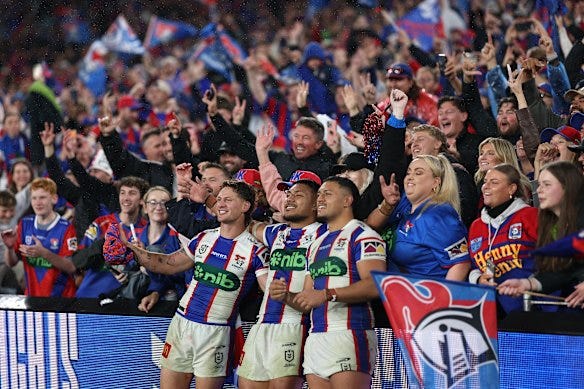
Grand Final week was about the Knights, that much was clear from the torrent of Knights themed content in the immediate aftermath of their preliminary final win over the Panthers, including the tears from the Johns brothers in their various media capacities, the red and blue wave that descended onto Olympic Park, the soaring share price of Sid Fogg’s, and all the requests to get the Screaming Jets or Silverchair to save the NRL’s Grand Final entertainment.
Hell, we even got a joint statement from the latter band saying go the Knights, that sort of reconciliation can only be mediated by a regional team going well, the lines have never been straighter.
Anyway, when you’re carrying the longest active Grand Final appearance drought in the league, not including the two clubs who came into the league most recently in the Titans (who may never get there) and the Dolphins (who Hyrox girl’d2 themselves in their home prelim), the natural inclination of the neutral public is to align themselves with the quintessential Cinderella run, especially considering the evil empire on the other side.
People will say that the Roosters were in their own Grand Final drought, and I suppose seven years is a long time when you “play for premierships”, but don’t insult my intelligence. The only interesting, and hilarious, spin on the Roosters Grand Final appearance drought is that Parramatta, a club in perpetual turmoil and flux, made it more recently than them (and proceeded to not show up on the day so can we really say they made it anyway?). The Tigers haven’t made a finals series, let alone a decider, since 2011, the Dragons last competed on the first Sunday in October in 2010, the Bulldogs in 2014, the Warriors in 2011, Manly 2013. Those are droughts belying clubs of their stature and fanbase, but I digress.
It was impossible to not get swept up in the romance of the Knights story. A side that hadn’t made a Grand Final since a generation ago, when the men from the Hunter swept aside one of the greatest attacking forces to win their second premiership in the 2001 Eels. In a salary-capped league of only 15-17 teams, never making it back there in a literal generation is almost as impressive as it is futile. There are qualified lawyers, tradespeople, teachers and doctors in Newcastle who haven’t been alive to witness a Knights Grand Final before last Sunday, it was a story of a fanbase being connected from the old era to the new, the passing down of stories, the fables of 2001 and 1997. People who knew of the city coming alive in lore only now witnessing in real time the allure and magic a premiership run can evoke.
In a way, the entire city was on that field in the preliminary final, carrying Sandon Smith’s little legs 80 metres downfield on full time to seal the victory. The city, forged in the mines and under the harsh sun, making the pilgrimage down the freeway to Olympic Park, and nothing was going to stop them, not even every NSW resident’s worst nightmare…planned trackwork.
This time last year Knights fans in workplaces across Australia were begrudgingly accepting their red and blue wrapped wooden spoons from snide colleagues, accompanied with a mirthless reassurance that next year will surely be better. The only way is up, things of that nature.
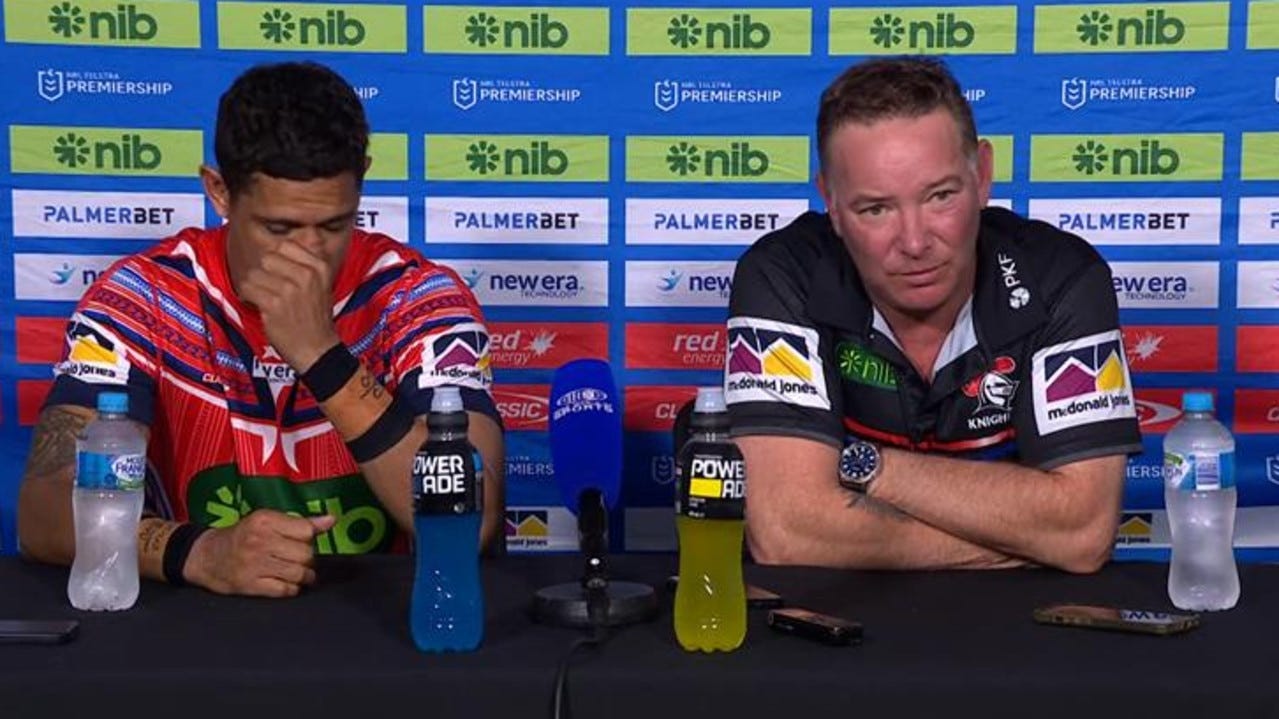
To be a team to go from the wooden spoon to the Grand Final in 12 months for the first time since, ironically, the Roosters in 2010, is no mean feat, especially when you consider the lens through which this team was analysed and examined in the preseason. I tried to find if I did a ladder prediction, either here or on Twitter, but it appears I didn’t, but I’ll let you know I definitely wouldn’t have put the Knights in the top eight, so take that for what it’s worth.
What I will recall though, is something I wrote back in March of last year, after it was announced that Dylan Brown had signed a ten year deal with Newcastle.
2035 is not a real year

I was kind of struggling to pick a topic for this week’s piece based on the round of footy we’d just witnessed. Punching down on the Eels is unbecoming, while I’m not going to go too early on the Roosters looking like Kurt Mann’s eye (although it might be one week away).
I would say the tone I convey there is one of confusion without trying to be too cynical, but it’s fair to say I was struggling to see the vision of giving Dylan Brown a decade long deal, even if I appreciated the logic of signing an established and talented, if frustrating, half.
While Brown himself struggled with injuries and ultimately missed the back half of the year, while he was in the side his combination with Kalyn Ponga and Fletcher Sharpe should set tongues wagging for future seasons, especially considering the considerable leaps forward Sharpe made as an actual halves option and not just an AJ Brimson “well we have a better fullback option so just chuck him in the halves and hope it works out” facsimile.
Of course, there’s the very real chance that this season was the creation of Newcastle’s white whale, and they return to purgatory and trudging through the desert that is constant 5-12th place finishes and first week exits, but I believe in the talent. The backrow of Manuleleua and McEwen could be one of the best in the league, and that’s ignoring Dylan Lucas who recovered from near amputation in record time to appear in the finals. Ponga had maybe the best season of his career, Sharpe is a star in waiting, there’s a cavalcade of young and promising middle forwards coming through, optimism is free and it definitely looks rosy.
As for Justin Holbrook, should he have won Coach of the Year? Yes, I think so, I certainly would’ve picked him anyway. The award is functionally “which coach dragged up a team we all thought was dogshit the most?” By any metric that was Holbrook. I do think a lot of the outrage over Andrew Webster winning it was fuelled by the respective finals runs the Knights and Warriors went on (including the Knights marching across the ditch and pillaging Eden Park), and fair enough, humans will be emotional, but when you remember this is a regular season only award, Webster is hardly a ludicrous winner, even if I would’ve voted Holbrook regardless.
Is three weeks of fairytales enough to wipe away a generation of ineptitude? Maybe? We’ll find out in a few months.
I have nothing to say about the Roosters, to be frank. There’s no romance in their story, just mercenaries and contract killers, and that’s ok. The “pay for premierships” edit to their silly slogan is fun to poke at, but it is somewhat borne out of geographical disadvantages (as much as it can suck being based at Bondi Beach) pertaining to rugby league heartland. There are stories of internal development worth highlighting, such as the rise of Naufahu Whyte, Robert Toia and Salesi Foketi, the maturation of Sam Walker (despite his relative stinker in the Grand Final), and the leap to supernova superstardom of future Wallabies quarter final loser Mark Nawaqanitawase (who surely comes back after dabbling in the 2027 Rugby World Cup).
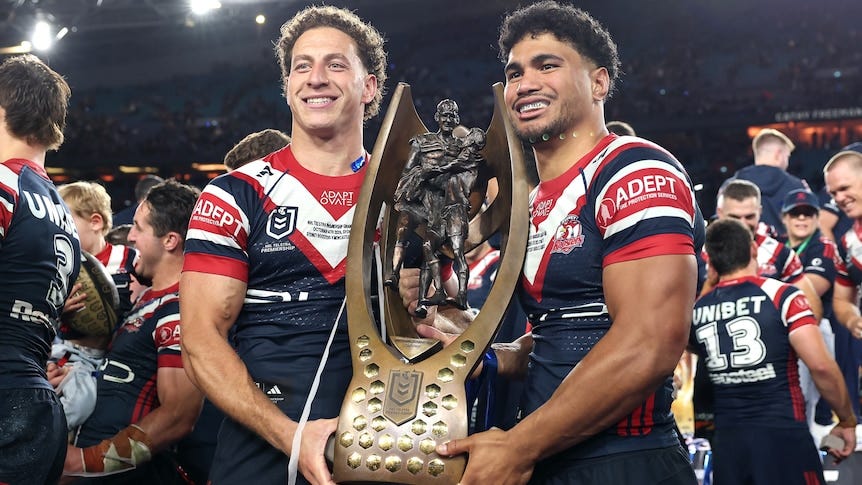
Do they get credit for being able to sign basically any free agent they want? No, but I think it is fair to credit their scouting in the pathways, because while this team isn’t exactly flush with local juniors, they’ve clearly done a great job identifying talent in New Zealand and the Central Coast in particular (as well as signing Origin incumbents like Reece Robson and Daly Cherry-Evans).
The game itself on Sunday was definitely one of the Grand Finals of all time, and even though the Knights streaked ahead to a 12-0 lead there was a feeling of inevitability about how the Roosters were trundling down the field with alarming ease. If you didn’t watch the game and just looked at the stat sheet, you’d think the Roosters won by 40 (and they probably should’ve).
The Roosters had 58% of the possession and completed 10 more sets, ran for 11 metres more per set than the Knights, had almost 700 more total running metres and 300 more post contact metres, tripled the Knights in kick return metres3, more than doubled up the Knights in offloads and tackle breaks, received four penalties to two, and only committed one set restart.45
I’m trying to formulate my ultimate take on what all these numbers mean but I’ve got several branches of said take, including but not limited to:
1. The Roosters halves were genuinely appalling considering the platform and possession they were afforded
2. The Roosters forwards were so utterly dominant that the majority of their kicks were contested bombs pinning the Knights in and stifling their early tackles out of yardage
3. The Knights scramble and edge defence was exemplary
James Tedesco won the Clive Churchill Medal for his 388 running metres, the first of his career. In the moments immediately following the game I said that I thought he would win it but I would’ve given it to Mark Nawaqanitawase, my justification being that not only was their entire offensive gameplan apparently just “kick it to Mark”, but he also effectively created two tries out of not much (as flukey as the double deflection was anyway) in a game decided by one point. That’s not nothing in a game of such fine margins.
The further we get from the game the more I think the medal should’ve gone to Naufahu Whyte. He had 17 runs for 189 metres, 78 of which were post contact. He had four tackle breaks, one line break and one offload, and made 28 tackles with three missed/ineffective. Not the greatest statistical output, for sure, but when a game develops into the meat grinder that this one became, where the Knights forward pack was getting absolutely monstered, you have to look at the root cause of that, and that was Whyte and the other Roosters forwards beating them to a pulp.
Tedesco was good, but a lot of what he did wouldn’t have been possible without his forwards laying the boom and forcing Sandon Smith and Fletcher Sharpe to constantly be kicking from their 30-metre line. It’s not a bad winner by any means, I just wouldn’t have given it to him, but anyway I’m not a voter, just a man with a keyboard.
Ok so I did have something to say about the Roosters. Congratulations to them on snapping their seven-year title drought.
Other Notes
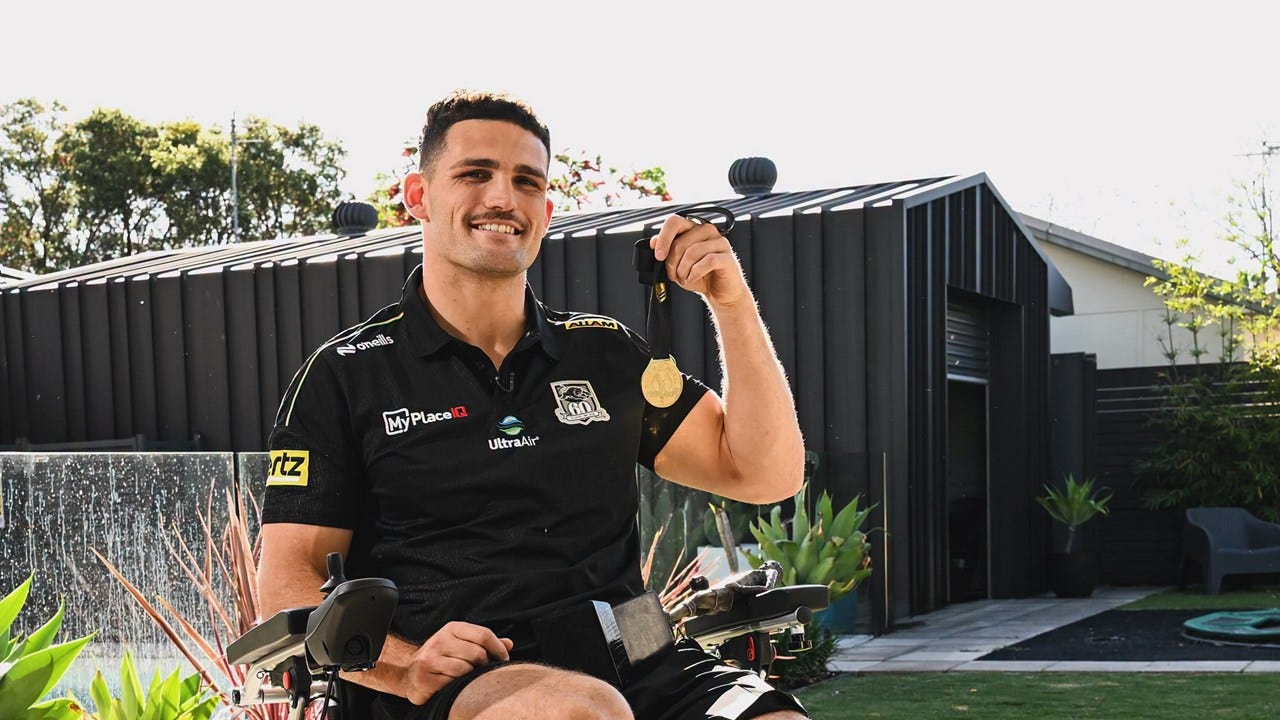
Nathan Cleary won his first Dally M medal to complete the set of accolades and had to accept the award from his couch after having his leg mangled so bad it invoked images in my mind of Kevin Ware for the University of Louisville over a decade ago. The voting process is so fraught now that it’s hard to really use the award as any sort of vindication or otherwise on a player’s standing in the game, but it is a welcome form of closure that the best player of his generation gets at least one Dally M for future historians to look at.
The Perth Bears are now officially on the clock. I had to refresh myself with their squad and, without spoiling any predictions I may make in February, my preliminary thoughts are I like them for a plucky 16th place finish. A squad that can only be described as “a collection of professional rugby league players” and a chairman who is already at risk of being fired thanks to an internal power struggle and board shenanigans6. At least they’re behaving like a rugby league club, it’s all going swimmingly.
The Rugby League World Cup starts in a little over a week with Australia vs. New Zealand on October 15th at Allianz Stadium. Squad announcements have been trickling in over the last couple of days. Anyone who has followed my work over the last few years knows how important I think the international game is, and I’ll hopefully have some form of content/preview early next week before the tournament kicks off.
Based on how it’s treated by the god kings in charge anyway
I would say look it up if you don’t get the reference but maybe it’s best if you don’t, for your algorithm’s sake
The Knights only had 100 return metres all game. Do you know how hard that is to have a number so low?
Smarter people than I have opinions and analysis on Adam Gee’s refereeing performance so I’ll abstain
All stats from the NRL.com Match Centre